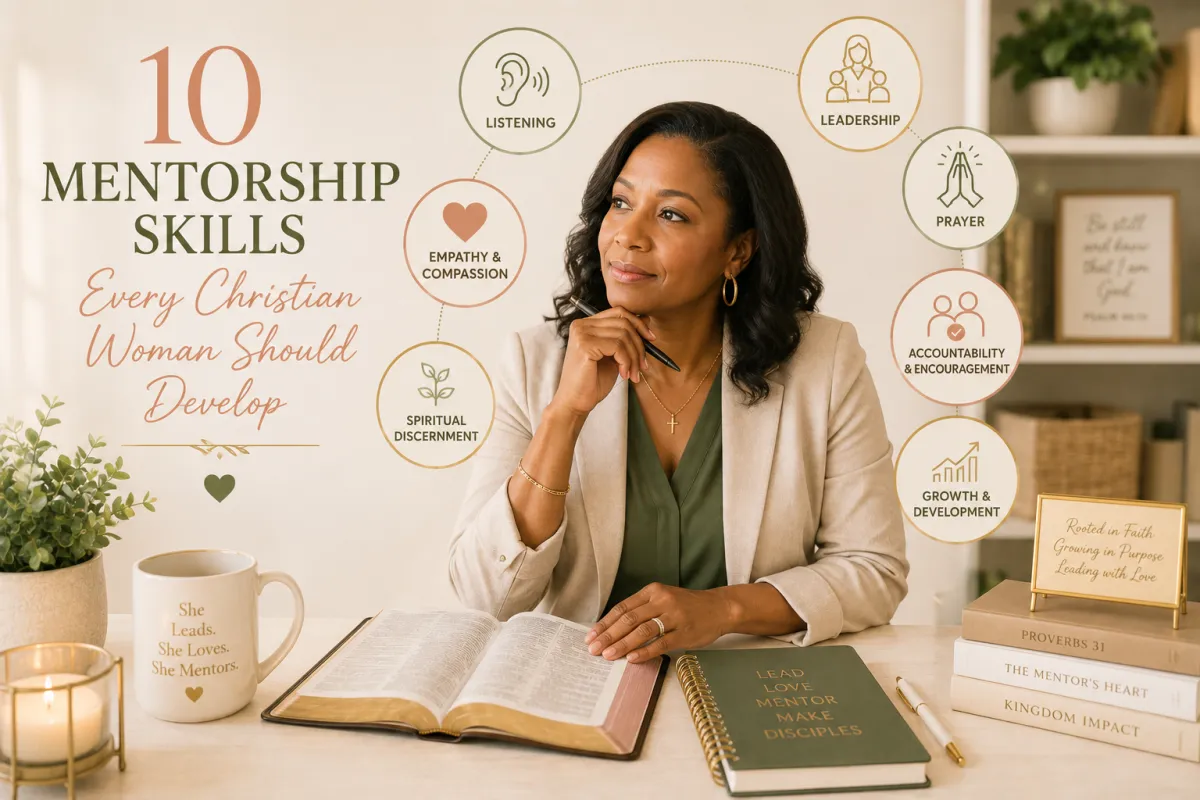
The Mentorship Skills Every Christian Woman Should Develop
Many women assume effective mentors are born, not developed.
They believe mentorship comes naturally to certain people.
That some women simply possess a special ability to guide, encourage, and influence others.
While some people may have natural gifts that support mentorship, the truth is this:
Great mentors are developed.
They learn.
They grow.
They practice.
They strengthen skills over time.
Just as leaders develop leadership skills and teachers develop teaching skills, mentors develop mentoring skills.
This should be encouraging.
Why?
Because it means mentorship is not reserved for a select few.
It is a learnable leadership discipline.
Women who are willing to grow can become powerful mentors regardless of their background, profession, or ministry experience.
The question is not whether you already possess every mentoring skill.
The question is whether you are willing to develop them.
Let's explore some of the most important mentorship skills every Christian woman should cultivate.
Skill #1: Active Listening
Listening may be the most underrated leadership skill in ministry today.
Many people listen with the intention of responding.
Effective mentors listen with the intention of understanding.
Active listening means:
Paying attention
Asking clarifying questions
Avoiding interruptions
Not immediately offering solutions
Seeking understanding before speaking
James 1:19 reminds us:
"Everyone should be quick to listen, slow to speak and slow to become angry."
Many mentees do not need immediate answers.
They need to feel heard.
The mentor who listens well often creates more impact than the mentor who speaks the most.
Skill #2: Asking Powerful Questions
Effective mentors understand that growth often happens through discovery.
Rather than immediately giving advice, they ask thoughtful questions.
Questions such as:
What do you believe God is showing you?
What options are available?
What is holding you back?
What would obedience look like here?
What step do you feel called to take next?
Questions create ownership.
Advice creates dependence.
When people discover truth for themselves, they are more likely to act upon it.
Jesus frequently used questions throughout His ministry.
Not because He lacked answers.
Because questions invite transformation.
Skill #3: Discernment
Discernment is the ability to recognize what is happening beneath the surface.
Mentors often hear what is said.
Discernment helps them notice what is not being said.
Discernment may reveal:
Fear disguised as indecision
Hurt disguised as anger
Insecurity disguised as perfectionism
Pride disguised as confidence
Spiritual discernment develops through:
Prayer
Scripture
Experience
Dependence upon the Holy Spirit
Discernment allows mentors to respond wisely rather than react emotionally.
Skill #4: Encouragement
The world offers plenty of criticism.
People desperately need encouragement.
Biblical encouragement is more than positive words.
It is helping someone see themselves through God's perspective.
Encouragement reminds people:
God is still working.
Growth is possible.
Failure is not final.
Their calling matters.
Their value comes from Christ.
Effective mentors consistently build courage in others.
In fact, the word encouragement literally means "to put courage into."
And courage is often exactly what people need.
Skill #5: Boundary Management
Healthy mentors understand that boundaries are not barriers.
They are protection.
Without boundaries:
Mentors become overwhelmed.
Mentees become dependent.
Expectations become unclear.
Relationships become unhealthy.
Boundary management includes:
Defining availability
Maintaining appropriate communication
Clarifying responsibilities
Understanding limitations
Practicing healthy self-care
One of the most loving things a mentor can do is establish healthy boundaries.
Boundaries create safety for everyone involved.
Skill #6: Accountability
Many people desire change.
Fewer people consistently pursue it.
Mentors help bridge that gap.
Accountability is not control.
It is support.
Effective accountability asks:
What commitment did you make?
What progress have you made?
What obstacles emerged?
What is your next step?
Accountability helps transform good intentions into meaningful action.
Growth rarely happens through inspiration alone.
It requires implementation.
Skill #7: Emotional Intelligence
Emotional intelligence is the ability to understand and manage emotions effectively.
Mentors who develop emotional intelligence can:
Navigate difficult conversations
Recognize emotional triggers
Remain calm under pressure
Respond thoughtfully rather than react impulsively
Build stronger relationships
Many mentoring challenges are not knowledge problems.
They are emotional awareness problems.
The ability to regulate your own emotions often determines how effectively you can help others manage theirs.
Skill #8: Spiritual Leadership
Christian mentorship differs from secular mentorship because spiritual growth remains central.
Spiritual leadership involves:
Modeling faith
Encouraging biblical truth
Pointing people toward Christ
Praying with wisdom
Supporting spiritual maturity
Mentors are not spiritual superheroes.
But they should consistently direct people back to God's truth rather than personal opinion.
Spiritual leadership helps maintain the Christ-centered focus of mentorship.
Skill #9: Humility
This may be the most important skill on the list.
Why?
Because humility keeps mentors teachable.
Humble mentors:
Continue learning
Welcome feedback
Admit mistakes
Seek counsel
Recognize limitations
Pride assumes:
"I have all the answers."
Humility says:
"I am still growing too."
The most effective mentors never stop being students.
Skill #10: Knowing When to Refer
One of the wisest skills a mentor can develop is recognizing when additional support is needed.
As discussed in last week's article, mentors should understand when situations require:
Counseling
Pastoral intervention
Medical support
Crisis resources
Specialized care
Referral is not weakness.
Referral is wisdom.
Healthy mentors know where their role ends and where professional expertise begins.

Why These Skills Matter
Imagine two women who both care deeply about helping others.
One relies solely on good intentions.
The other develops mentoring skills intentionally.
Which mentor is likely to create greater impact?
The answer is obvious.
Compassion is essential.
But compassion becomes far more effective when supported by skill.
These mentoring skills help women:
Serve confidently
Build healthier relationships
Avoid burnout
Create meaningful growth
Lead with wisdom
The goal is not perfection.
The goal is progress.
Every skill can be developed.
Every mentor can grow.
Every leader can improve.
The Church Needs Equipped Mentors
Today's women face challenges that previous generations could never have imagined.
Isolation.
Overwhelm.
Confusion.
Pressure.
Fear.
Uncertainty.
The Church needs women who can walk alongside others with wisdom and grace.
Not because they are perfect.
But because they are prepared.
Women who listen well.
Lead wisely.
Discern carefully.
Encourage faithfully.
And point consistently toward Christ.
These are the mentors who strengthen churches.
These are the mentors who develop leaders.
These are the mentors who leave lasting Kingdom impact.
If you've been sensing a call to encourage, guide, and invest in other women, remember this:
You do not need to have everything figured out before you begin.
You simply need a willingness to grow.
Over the coming weeks, I'll be sharing more resources, training opportunities, and mentorship insights designed to help Christian women mentor with confidence, wisdom, and biblical integrity.
Because strong mentors are not born.
They are developed.
And the Church needs them now more than ever.
With purpose and conviction,
Dr. Deidre Proctor, dba/min.ldrshp (hc)
Faith-Based Leadership & Mentorship Architect
Founder, Rooted in His Purpose Mentorship™


