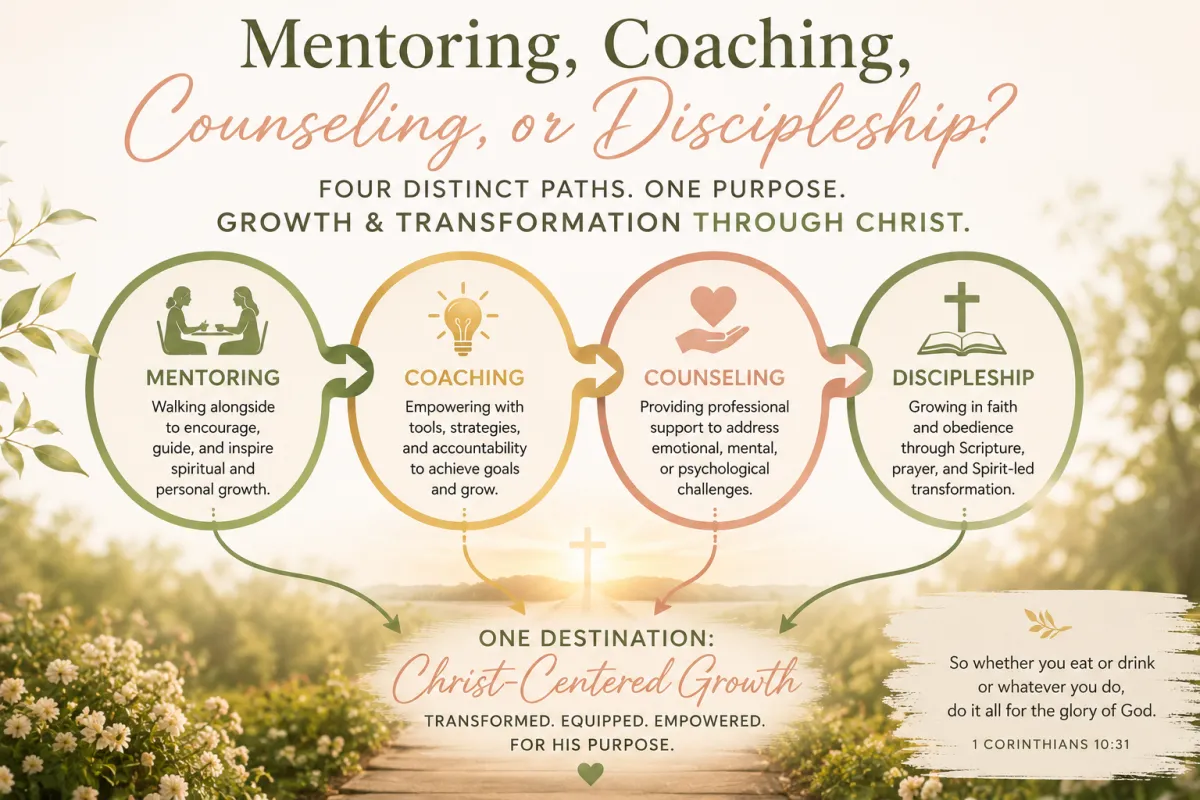
The Difference Between Mentoring, Coaching, Counseling, and Discipleship
One of the most common sources of confusion in ministry is understanding the difference between mentoring, coaching, counseling, and discipleship.
Many churches use these terms interchangeably.
Many leaders assume they all mean essentially the same thing.
Many women who feel called to help others find themselves unsure where their role begins and where it ends.
As a result, mentors sometimes attempt to counsel.
Coaches sometimes begin discipling.
Discipleship leaders sometimes take on mentoring responsibilities.
And everyone ends up operating without clarity.
The problem is not passion.
The problem is misunderstanding.
Each of these roles serves an important purpose.
Each creates value.
Each supports growth.
But each has a distinct focus and responsibility.
Understanding those differences helps leaders serve with greater confidence, wisdom, and effectiveness.
Most importantly, it protects both the helper and the person receiving support.
Why Role Clarity Matters
Imagine visiting a doctor for heart surgery and discovering halfway through the consultation that he is actually a dentist.
Both professions are valuable.
Both help people.
But they serve very different functions.
The same principle applies in ministry.
When we misunderstand our role, we risk addressing needs we are not equipped to handle.
We may unintentionally create dependency.
We may overlook deeper issues.
We may fail to provide the support someone truly needs.
Role clarity creates safety.
It creates confidence.
And it allows each person to serve within their God-given assignment.
Let's explore each role individually.
What Is Mentoring?
Mentoring is a relationship-centered process where a more experienced individual helps another person grow through wisdom, guidance, encouragement, and shared experience.
Mentors draw heavily from:
Personal experience
Life lessons
Leadership wisdom
Spiritual maturity
Practical insight
Mentors often help people navigate:
Life transitions
Leadership development
Personal growth
Decision-making
Faith journeys
Ministry challenges
A mentor might say:
"When I walked through a similar situation, here's what I learned."
Mentoring is generally relational and developmental.
The goal is growth through guidance.
Mentors help individuals gain wisdom and perspective.
The Focus of Mentoring
Mentoring primarily asks:
"How can I help this person grow through guidance and experience?"
Mentoring often looks backward and forward.
The mentor reflects on lessons learned while helping the mentee prepare for the future.
Mentoring is less about providing expert solutions and more about sharing wisdom gained through experience.
What Is Coaching?
Coaching is a structured process that helps individuals move from where they are to where they want to be.
Unlike mentoring, coaching relies less on personal advice and more on powerful questions.
Coaches help people:
Clarify goals
Identify obstacles
Develop action plans
Increase accountability
Create measurable progress
A coach might ask:
What outcome do you want?
What options are available?
What's stopping you?
What's your next step?
Notice the difference.
A mentor often shares experience.
A coach primarily facilitates discovery.
The Focus of Coaching
Coaching asks:
"How can I help this person achieve a specific goal?"
Coaching is future-focused.
It emphasizes action, accountability, and progress.
Rather than telling people what to do, coaches help individuals uncover their own answers and take ownership of their growth.
What Is Counseling?
Counseling focuses on healing, recovery, and emotional well-being.
Professional counselors are trained to address:
Trauma
Anxiety
Depression
Grief
Addiction
Relationship issues
Mental health concerns
Counseling often explores:
Emotional wounds
Past experiences
Behavioral patterns
Psychological challenges
A counselor helps people understand, process, and heal from experiences that may be affecting their present lives.
The Focus of Counseling
Counseling asks:
"What needs healing?"
Counseling frequently looks backward to understand present challenges.
Its purpose is restoration and emotional health.
This is why mentors should never attempt to function as therapists or mental health professionals unless they are specifically trained and licensed to do so.
Compassion does not replace clinical expertise.
Wisdom includes recognizing limitations.
What Is Discipleship?
Discipleship focuses on spiritual formation.
It is the intentional process of helping someone become more like Christ.
Discipleship involves:
Biblical teaching
Spiritual growth
Prayer
Obedience
Character development
Faith maturity
Jesus modeled discipleship throughout His ministry.
He taught His followers.
Corrected them.
Encouraged them.
Challenged them.
And ultimately prepared them to continue His mission.
Discipleship is rooted in spiritual transformation.
The Focus of Discipleship
Discipleship asks:
"How can I help this person grow closer to Christ?"
Its primary goal is spiritual maturity.
Discipleship develops faith, character, and obedience.
It is less concerned with achievement and more concerned with becoming.

How These Roles Overlap
This is where confusion often develops.
While mentoring, coaching, counseling, and discipleship are distinct, they frequently overlap.
For example:
A mentor may use coaching questions.
A discipleship relationship may include mentoring.
A counselor may encourage spiritual growth.
A coach may help someone strengthen leadership skills.
The overlap is natural.
The key is understanding your primary role.
You can borrow tools from other disciplines without becoming those disciplines.
A mentor may ask coaching questions.
That does not make her a coach.
A mentor may pray with someone.
That does not automatically make the relationship discipleship.
A mentor may listen compassionately.
That does not make her a counselor.
Role clarity helps maintain healthy boundaries.
Why This Matters for Mentors
Many new mentors unintentionally drift into roles they were never meant to carry.
They become:
Amateur therapists
Decision-makers
Crisis managers
Spiritual directors
Emotional rescuers
Not because they want to.
Because they care.
But caring without clarity often creates confusion.
Healthy mentors understand:
What they are called to do
What they are not called to do
When referral is appropriate
When additional support is needed
This protects everyone involved.
The Power of Staying in Your Lane
One of the wisest things a mentor can learn is this:
You do not have to do everything to be effective.
In fact, the most effective mentors often know exactly where their responsibilities end.
They guide.
They encourage.
They ask thoughtful questions.
They share wisdom.
They provide accountability.
And when situations exceed their expertise, they confidently refer.
That is not weakness.
That is leadership.
The goal is not to become everything for someone.
The goal is to help them access the support they need.
What the Church Needs Most
The Church does not need mentors trying to be counselors.
It does not need coaches attempting therapy.
It does not need discipleship leaders carrying responsibilities beyond their role.
What the Church needs are equipped leaders who understand their assignments.
When mentoring, coaching, counseling, and discipleship each operate within their intended purpose, people receive better support.
Leaders serve with greater confidence.
Churches function more effectively.
And ministry becomes healthier for everyone involved.
If you've ever felt uncertain about where mentoring begins and where other helping roles end, you're not alone.
Many women have a heart to serve but have never received guidance on how to navigate these important distinctions.
Over the coming weeks, I'll continue sharing practical mentorship principles, ethical leadership insights, and biblical guidance designed to help Christian women serve with wisdom, confidence, and integrity.
Because effective mentors don't try to do everything.
They learn how to do the right things well.
With purpose and conviction,
Dr. Deidre Proctor, dba/min.ldrshp (hc)
Faith-Based Leadership & Mentorship Architect
Founder, Rooted in His Purpose Mentorship™


